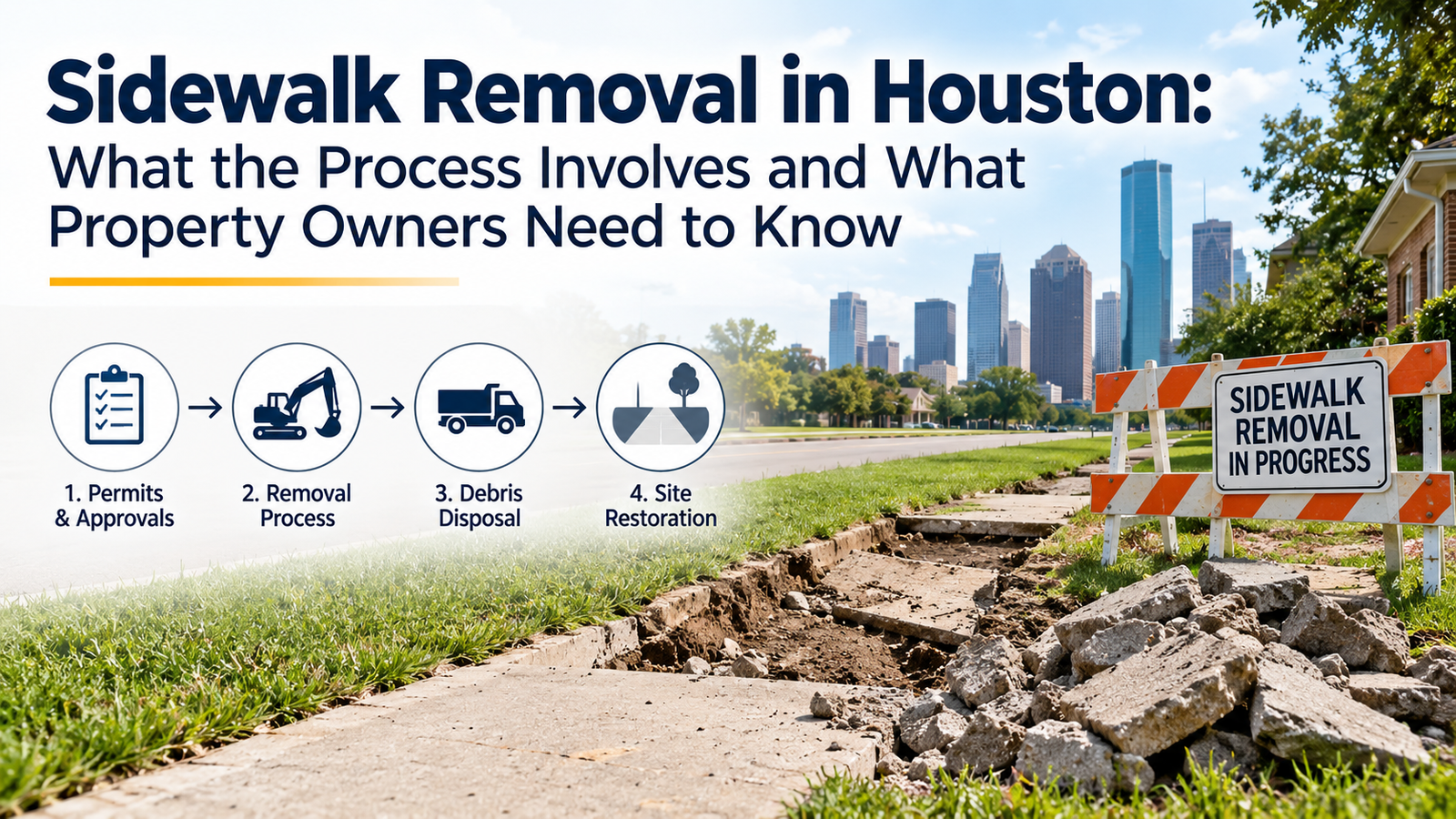
Sidewalks are among the most common concrete surfaces removed and replaced across Houston every year. The combination of the city’s expansive clay soils, heavy rainfall, mature tree canopies, and decades of thermal cycling creates conditions that are genuinely hard on concrete flatwork. What begins as a hairline crack or a slightly raised panel can progress into a tripping hazard, a drainage problem, or an ADA compliance issue that demands professional attention. Understanding what Sidewalk Removal Houston actually involves from permit requirements through the physical process and site preparation helps property owners and contractors approach these projects with the right expectations.
Why Houston Sidewalks Deteriorate
Houston’s expansive clay soils are the primary force behind sidewalk deterioration across the region. These soils known locally as “black gumbo” swell when saturated with rainfall and contract as they dry out during hot, dry periods. The City of Houston averages roughly 50 inches of annual precipitation, but that rainfall is distributed unevenly, with wet periods followed by stretches of dry weather. This constant expansion and contraction applies differential upward and downward pressure to concrete panels, causing them to crack, tilt, and develop height differences between adjacent sections.
Tree root intrusion is the second most common cause of sidewalk failure in Houston’s older neighborhoods. The mature tree canopies that shade neighborhoods like the Heights, Montrose, Midtown, and the inner loop are an asset to the community but the root systems of these trees extend horizontally far beyond their canopy drip lines, often directly beneath sidewalk panels. As roots grow in diameter over years and decades, they exert sustained upward pressure that lifts concrete panels, creating dramatic elevation changes and serious trip hazards.
Houston’s heat and UV exposure accelerate concrete surface deterioration. Extended periods of temperatures above 95°F cause thermal expansion that can close control joints completely, generating compressive stress that leads to spalling and edge failure. UV radiation oxidizes the surface paste of the concrete, reducing surface strength over time. Sidewalk panels that have been in place for 30 or more years have typically accumulated the effects of all these deterioration mechanisms simultaneously.
Houston’s Sidewalk Permit Requirements
The City of Houston Permitting Center manages sidewalk-related permits through its Traffic Right of Way division. For most residential sidewalk removal and replacement projects, the applicable permit is the Residential Driveway, Sidewalk, or Curb and Gutter Permit, which covers the construction of new sidewalks and the removal and replacement of existing ones. Commercial projects require the parallel Commercial Driveway, Sidewalk, or Curb and Gutter Permit.
Houston’s permitting process requires traffic-approved stamped plans for sidewalk work, and inspections are required both before and after concrete placement. The permit is valid for one year, and any changes to the approved permit require a revision process. Work affecting the public right-of-way which includes any sidewalk adjacent to a public street is specifically managed by the City of Houston’s Office of the City Engineer through the Traffic Right of Way section.
There is an important exception for small-scale residential repairs. Houston’s ordinance allows residential homeowners to repair and replace portions of an existing sidewalk without a permit or bond if the scope qualifies as minor panel replacement under the Residential Sidewalk Panel Replacement provision. This provision has specific eligibility criteria the area of repair must be limited, and the work must not alter the sidewalk alignment or grade significantly. Contractors familiar with Houston’s permitting structure understand when this exception applies and when a full permit is required.
Houston also has active sidewalk policies under the Planning and Development Department that require sidewalk plan approval as a condition of certain construction permits. New single-family residential construction, additions or alterations to non-single-family structures, and reconstruction of parking lots above specified thresholds all trigger sidewalk plan review. These requirements reflect the City’s ongoing effort to build out and improve its pedestrian network across Houston’s diverse neighborhoods.
The Sidewalk Removal Process
Professional sidewalk removal in Houston begins with assessment of the existing conditions. The contractor evaluates the extent of the damage, identifies panel boundaries, checks for subsurface issues that may have contributed to the deterioration (particularly tree roots), and determines whether any adjacent elements curbs, drainage inlets, utility cleanouts, or building approach concrete will be affected by the removal.
When tree roots are involved, the removal plan must address the root situation as well as the concrete. Simply removing the sidewalk and pouring new concrete over an untreated root system will result in the same failure recurring within a few years. Options include root pruning (cutting the offending roots back from the sidewalk zone), installation of root barriers that redirect future root growth, or in some cases working with an arborist to assess whether the tree’s long-term health is compatible with a sidewalk in that location.
The physical removal of concrete sidewalk panels involves breaking the concrete into manageable pieces using a hydraulic breaker attachment on a mini-excavator or a pneumatic jackhammer, depending on the access and panel thickness. Houston residential sidewalks are typically 4 inches thick with wire mesh or rebar reinforcement. The breaker fractures the panel, the pieces are loaded by hand for smaller jobs, or with a compact machine for larger projects and hauled away. Rebar is separated for scrap metal recycling. The broken concrete is recycled as crushed aggregate at processing facilities that serve the Houston construction market.
After the old concrete is removed, the subgrade is assessed and prepared. Any root material is cleared from the subbase area. The subgrade is regraded to the design elevation and cross-slope, providing proper drainage in the new sidewalk and adequate thickness for the new concrete pour. Compaction of the prepared subgrade ensures a stable, consistent base for the replacement concrete.
Sidewalk Removal for Construction and Development Projects
Beyond individual panel replacement, sidewalk removal in Houston frequently occurs as part of larger construction and development projects. New building construction, building additions, and significant renovations that require sidewalk plan approval also commonly require removal and replacement of existing sidewalk to meet current City of Houston sidewalk standards including minimum width requirements, accessibility ramp design, and surface specifications that may not be met by older sidewalk installations.
Utility installation projects regularly require sidewalk removal along portions of the public right-of-way. When water mains, sewer lines, or other utilities must be repaired or upgraded beneath a sidewalk, the sidewalk must be removed and restored as part of the utility project scope. Houston Public Works and private utility contractors both regularly perform sidewalk removal for utility access throughout the city.
The City of Houston’s ongoing drainage and flood mitigation projects including bayou improvement projects, drainage ditch reconstruction, and stormwater infrastructure upgrades that followed the lessons of Hurricane Harvey have generated significant sidewalk removal and replacement work along affected corridors throughout Harris County.
Recycling and Disposal of Sidewalk Concrete in Houston
Concrete from Houston sidewalk removal is a recyclable material with active demand in the regional construction market. Removed sidewalk concrete is transported to concrete recycling facilities where it is crushed into recycled concrete aggregate (RCA). This material is used as base course material for roads, driveways, and construction sites throughout the Houston metro area. The recycling pathway reduces landfill disposal costs, supports the regional construction material supply, and reduces the environmental footprint of sidewalk replacement projects.
Wire mesh or rebar reinforcement recovered during sidewalk removal is separately recycled as scrap steel. The scrap value of steel reinforcement from larger sidewalk removal projects can meaningfully offset hauling costs.
Frequently Asked Questions About Sidewalk Removal in Houston
Do I need a permit to remove and replace a sidewalk in Houston? In most cases, yes. The City of Houston requires a permit for sidewalk removal and replacement through the Houston Permitting Center’s Traffic Right of Way division. Minor residential panel repairs may qualify for an exception under the Residential Sidewalk Panel Replacement provision, but this has specific eligibility criteria. Working with a licensed contractor familiar with Houston’s permitting requirements ensures compliance.
Can sidewalk concrete be left in place and covered with new concrete? No. Pouring new concrete over deteriorated existing concrete is not a professional or durable repair approach, and it is not permitted by the City of Houston’s sidewalk standards. The existing concrete must be removed and the subgrade properly prepared before new concrete is placed.
How long does sidewalk removal and replacement take in Houston? A single sidewalk panel replacement is typically a one-day project. Longer sections a full block face or multiple connected sections may take two to three days for removal, subgrade preparation, forming, and concrete placement. Additional curing time is required before the replacement sidewalk is open to foot traffic.